Ionogram Filter — Coherent Echo Cleaning
Six-Stage Post-Extraction Noise Rejection
Apply IonogramFilter to a VIPIR RIQ echo cloud to remove RFI,
non-planar wavefront returns, multi-hop ground echoes, and isolated noise —
with optional temporal coherence enforcement across multiple soundings.
Two example scripts are provided:
| Script | Description |
|---|---|
examples/vipir/ionogram_filter_wi937.py |
Single WI937 sounding — stages 1–5 |
examples/vipir/ionogram_filter_pl407.py |
Single PL407 sounding — stages 1–5 (n_rx=2, no EP/XL/YL) |
examples/vipir/ionogram_filter_multi.py |
Multiple PL407 soundings — stages 1–6 including temporal coherence |
Filter stages
Echo cloud (EchoExtractor.to_dataframe())
         │
         ▼
  Stage 1 — RFI blanking
         │  Remove frequencies where echo height IQR > rfi_height_iqr_km
         ▼
  Stage 2 — EP filter
         │  Reject echoes with EP (wavefront residual) > ep_max_deg
         ▼
  Stage 3 — Multi-hop removal
         │  Flag 2F / 3F echoes at N×h*(1F) that are ≥ snr_margin_db weaker
         ▼
  Stage 4 — DBSCAN noise rejection
         │  Cluster in (f, h, V*, A, EP) space; label −1 = noise
         ▼
  Stage 5 — RANSAC trace fitting
         │  Fit polynomial h*(f); reject echoes > ransac_residual_km from curve
         ▼
  Stage 6 — Temporal coherence  ← multi-sounding only
         │  Keep (f, h) cells populated in ≥ temporal_min_soundings soundings
         ▼
  Filtered DataFrame
Example 1 — Single sounding (WI937)
Script: examples/vipir/ionogram_filter_wi937.py
Steps
1 — Load and extract
from pynasonde.vipir.riq.echo import EchoExtractor
from pynasonde.vipir.riq.parsers.read_riq import VIPIR_VERSION_MAP, RiqDataset

riq = RiqDataset.create_from_file(
    "examples/data/WI937_2022233235902.RIQ",
    unicode="latin-1",
    vipir_config=VIPIR_VERSION_MAP.configs[1],
)
ext = EchoExtractor(
    sct=riq.sct, pulsets=riq.pulsets,
    snr_threshold_db=3.0,
    min_height_km=60.0,
    max_height_km=1000.0,
).extract()
2 — Configure and run the filter
from pynasonde.vipir.riq.parsers.filter import IonogramFilter

filt = IonogramFilter(
    rfi_enabled=True,       rfi_height_iqr_km=300.0,
    ep_filter_enabled=True, ep_max_deg=90.0,
    multihop_enabled=True,  multihop_orders=(2, 3), multihop_snr_margin_db=6.0,
    dbscan_enabled=True,    dbscan_eps=1.0, dbscan_min_samples=5,
    ransac_enabled=True,    ransac_residual_km=100.0,
    temporal_enabled=False,   # single sounding — stage 6 skipped automatically
)

df_clean = filt.filter(ext)
print(filt.summary())
Sample output:
Stage         Input  Rejected  Kept   Retention
─────────────────────────────────────────────────
RFI            3206        12  3194     99.6 %
EP             3194       281  2913     91.2 %
Multi-hop      2913        87  2826     97.0 %
DBSCAN         2826       179  2647     93.7 %
─────────────────────────────────────────────────
Total          3206       559  2647     82.6 %
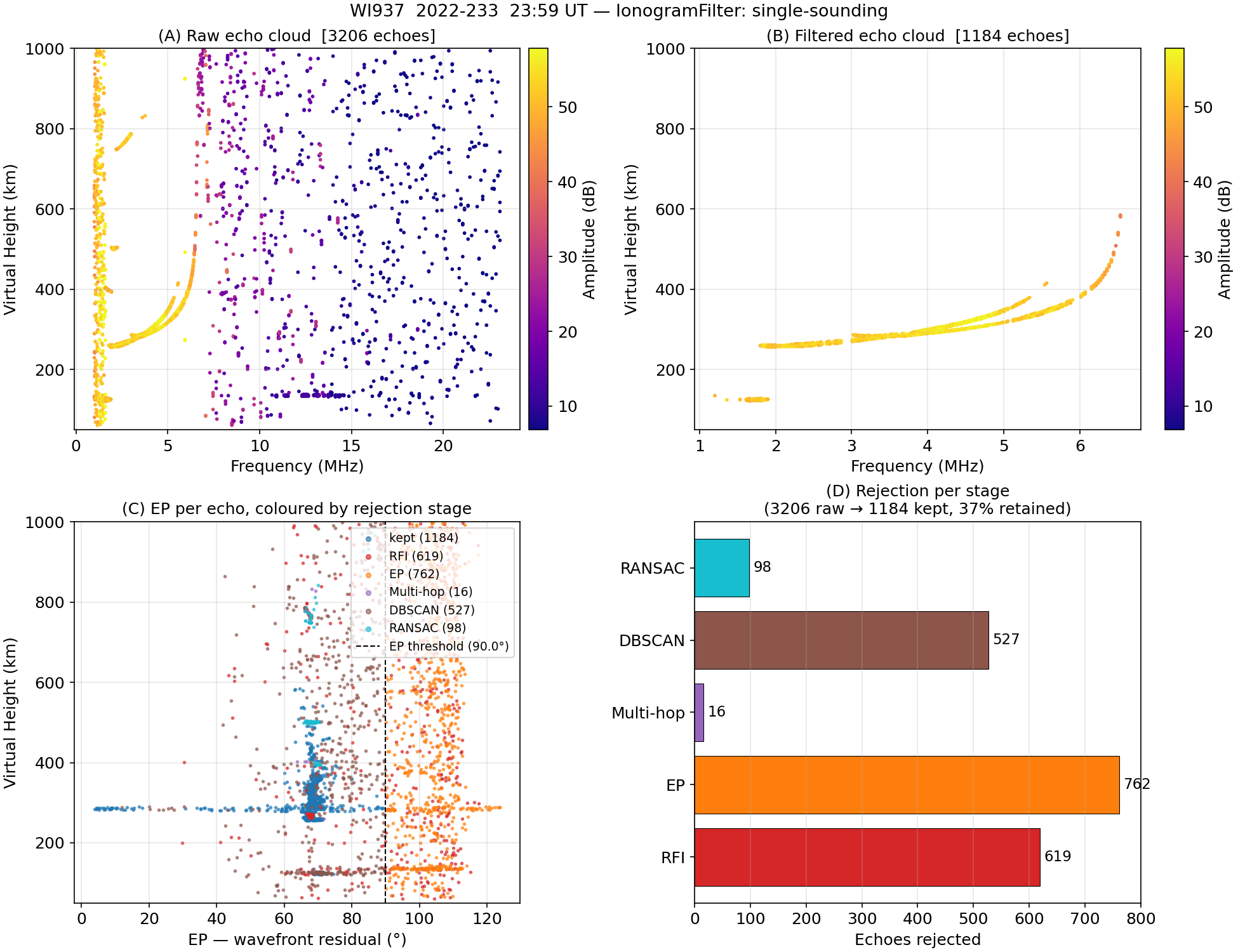
Output figure panels
| Panel | Contents |
|---|---|
| (A) Raw ionogram | Echo cloud before filtering |
| (B) Filtered ionogram | Echo cloud after all 4 stages |
| (C) EP vs height | Each echo coloured by which stage rejected it |
| (D) Rejection bar chart | Count of echoes removed per stage |
Run
Example 2 — Single sounding (PL407)
Script: examples/vipir/ionogram_filter_pl407.py
PL407 uses vipir_version=1 / data_type=2 (configs[0]) and has only 2 receivers,
so XL, YL, and EP are all NaN. DBSCAN omits residual_deg; stages 1–5 apply.
filt = IonogramFilter(
    rfi_height_iqr_km=300.0,
    ep_max_deg=90.0,           # no-op (EP all NaN for PL407)
    dbscan_features=(
        "frequency_khz", "height_km",
        "velocity_mps", "amplitude_db",
        # residual_deg omitted — entirely NaN for n_rx=2
    ),
    temporal_enabled=False,
)
Example 3 — Multiple soundings (temporal coherence)
Script: examples/vipir/ionogram_filter_multi.py
Add more consecutive RIQ files to the fnames list:
fnames = [
    "examples/data/PL407_2024058061501.RIQ",
    # "examples/data/PL407_2024058062001.RIQ",   # add consecutive soundings
    # "examples/data/PL407_2024058062501.RIQ",
    # "examples/data/PL407_2024058063001.RIQ",
    # "examples/data/PL407_2024058063501.RIQ",
]
Stage 6 (temporal coherence) activates automatically when len(extractors) > 1:
filt = IonogramFilter(
    temporal_enabled=True,
    temporal_min_soundings=3,       # cell must appear in ≥ 3 soundings
    temporal_freq_bin_khz=50.0,
    temporal_height_bin_km=50.0,
)

df_clean = filt.filter(extractors)  # list of EchoExtractor objects
# "sounding_index" column distinguishes soundings in the output DataFrame
How temporal coherence works
cell(f, h) = (round(f / 50 kHz), round(h / 50 km))

for each sounding i:
    mark all cells present in sounding i

occupancy(cell) = number of soundings containing that cell

keep echo  ←→  occupancy(cell) >= temporal_min_soundings
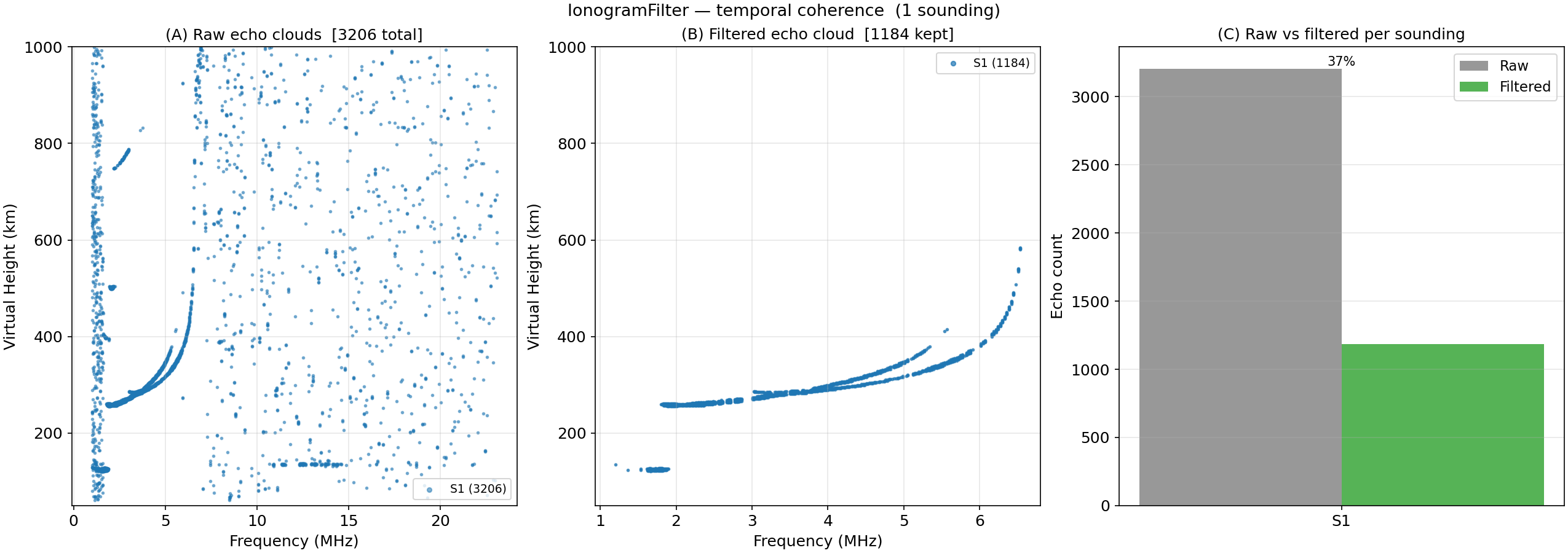
Real echoes follow the ionospheric trace and appear in the same (f, h) cell across consecutive soundings. Noise hits are random and rarely repeat.
Output figure panels
| Panel | Contents |
|---|---|
| (A) Stacked raw clouds | All soundings overlaid, one colour per sounding |
| (B) Filtered cloud | Temporally coherent echoes only |
| (C) Per-sounding counts | Bar chart of raw vs filtered echo count per sounding |
Run
Tuning guide
RFI height-spread threshold
rfi_height_iqr_km=300.0 is a good starting point. Ionospheric echoes cluster
tightly in height (IQR < 150 km); RFI scatters across all gates (IQR > 300 km).
Tighten to 150–200 km for low-noise environments; loosen for spread-F conditions
where the real trace can have a naturally elevated IQR.
RANSAC trace fitting
ransac_residual_km=100.0 is generous and tolerates spread-F. Reduce to 50 km
to enforce a tight single-layer trace. Increase ransac_n_iter (e.g. 500) or
ransac_min_inlier_fraction (e.g. 0.5) for noisier soundings.
EP threshold
ep_max_deg=90.0 is a conservative default that passes oblique real echoes
(which routinely reach 50–80°). Lower to 45° for strict planar-wavefront quality;
raise above 90° only to disable the stage. For instruments with n_rx < 3 (e.g.
PL407), EP is NaN and this stage is automatically a no-op.
DBSCAN parameters
dbscan_eps=1.0 means echoes must be within ≈ 1 IQR of each other in every
feature dimension to be neighbours. Increase for sparser soundings; decrease
for dense echo clouds where noise clusters are easily distinguished.
dbscan_min_samples=5 sets the minimum cluster size. Reducing to 3 retains
smaller clusters (weaker real echoes) at the cost of more noise surviving.
Temporal coherence bin size
Larger bins (temporal_freq_bin_khz=100, temporal_height_bin_km=100)
capture echoes that drift slightly between soundings; smaller bins enforce
stricter consistency.
Related
- IonogramFilter API
- Echo Extraction — WI937
- Drift Velocity Example
pynasonde/vipir/riq/parsers/filter.py