Drift Velocity — WI937
3-D Ionospheric Drift Velocity from a VIPIR RIQ File
Estimate the full [Vx, Vy, Vz] drift vector from
line-of-sight velocity measurements extracted by
EchoExtractor, using height-binned weighted least-squares
with iterative sigma-clipping.
Script: examples/vipir/drift_velocity_wi937.py
Physics background
Each ionospheric echo returns one line-of-sight (LOS) velocity measurement:
The direction cosines are computed from the echo's own echolocation parameters (XL, YL, virtual height R′):
Stacking many echoes with geometrically diverse arrival directions gives the overdetermined system A v = V* which is solved by weighted least-squares. Iterative sigma-clipping removes echoes whose LOS velocity is inconsistent with the bulk solution.
Steps
1 — Load and extract echoes
from pynasonde.vipir.riq.echo import EchoExtractor
from pynasonde.vipir.riq.parsers.read_riq import VIPIR_VERSION_MAP, RiqDataset

riq = RiqDataset.create_from_file(
    "examples/data/WI937_2022233235902.RIQ",
    unicode="latin-1",
    vipir_config=VIPIR_VERSION_MAP.configs[1],  # vipir_version=0 / data_type=1
)

extractor = EchoExtractor(
    sct=riq.sct,
    pulsets=riq.pulsets,
    snr_threshold_db=3.0,
    min_height_km=60.0,
    max_height_km=1000.0,
    min_rx_for_direction=3,
    max_echoes_per_pulset=5,
)
extractor.extract()
min_rx_for_direction=3 ensures XL, YL (and therefore direction cosines)
are available. WI937 has 8 receivers so this is always satisfied.
2 — Whole-sounding fit
df_whole = extractor.fit_drift_velocity(
    height_bin_km=None,   # single fit over all echoes
    min_echoes=6,
    snr_weight=True,
    n_sigma=2.5,
    max_ep_deg=None,      # skip EP pre-filter
)
height_bin_km=None produces one row with the bulk [Vx, Vy, Vz] for the
entire sounding — useful as a sanity check before height-resolved analysis.
Sample output:
=== Whole-sounding drift velocity ===
  Vx =  +32.4 m/s  (East)
  Vy =  -18.7 m/s  (North)
  Vz =   -5.1 m/s  (Vertical)
  RMS LOS residual :  41.3 m/s
  Condition number :   6.2
  Echoes used      :  312  (rejected: 24)
3 — Height-binned fit
df_bins = extractor.fit_drift_velocity(
    height_bin_km=10.0,   # 10 km bins
    min_echoes=6,
    snr_weight=True,
    n_sigma=2.5,
    max_ep_deg=None,
)
Returns one row per height bin that had ≥ min_echoes valid echoes with
finite XL/YL/V*.
Output columns:
| Column | Description |
|---|---|
height_bin_km |
Bin centre altitude (km) |
vx_mps |
East component (m/s) |
vy_mps |
North component (m/s) |
vz_mps |
Vertical component (m/s) |
residual_mps |
Mean absolute LOS residual after sigma-clipping |
condition_number |
Condition number of the weighted design matrix |
n_echoes |
Echoes used in the final fit |
n_rejected |
Echoes removed by sigma-clipping |
4 — Output figure
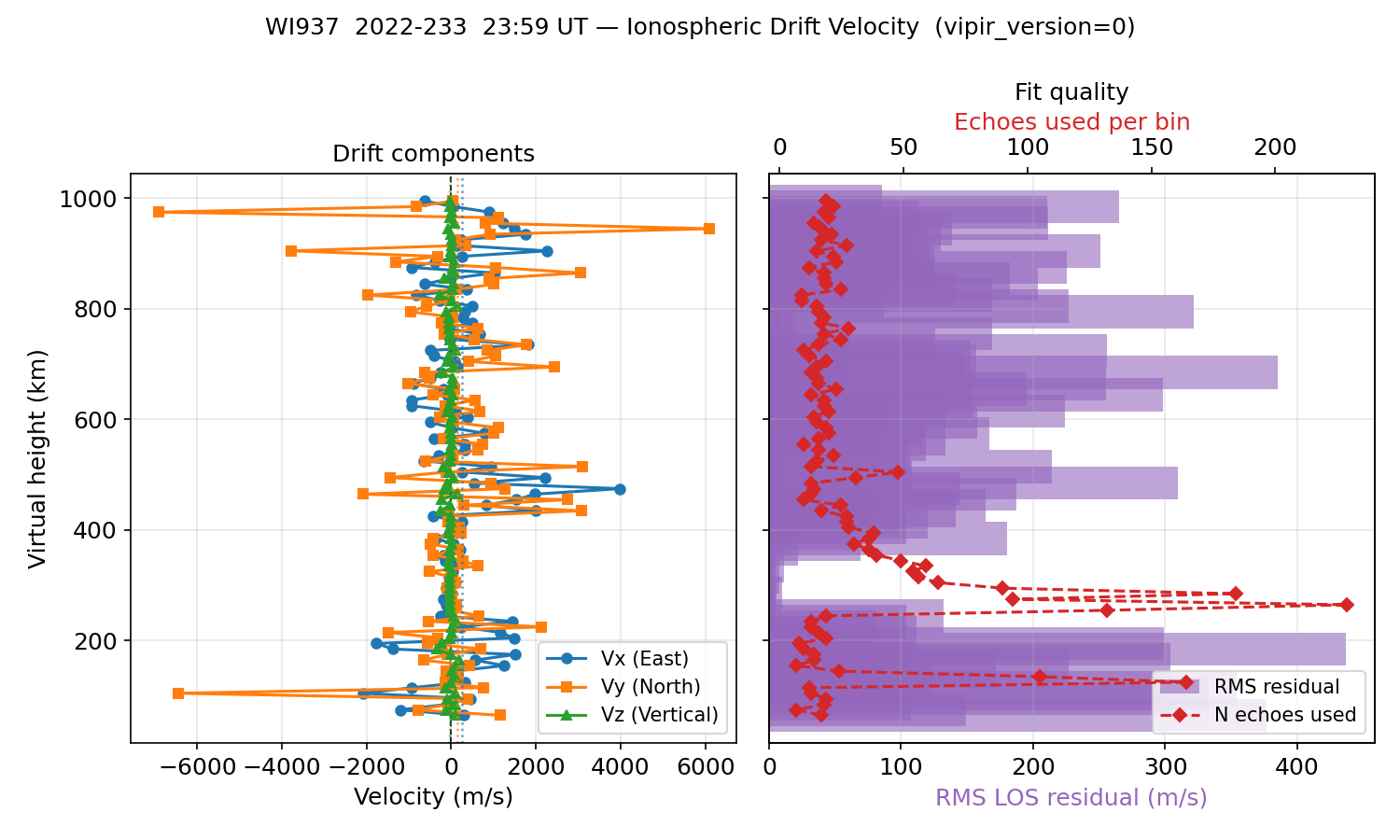
A 2-panel figure is saved to docs/examples/figures/drift_velocity_wi937.png:
| Panel | Contents |
|---|---|
| (A) Drift components vs height | Vx (blue), Vy (orange), Vz (green) as lines; dotted verticals show the whole-sounding estimate |
| (B) Fit quality vs height | RMS LOS residual (bar, purple) + echo count per bin (line, red) on dual x-axes |
Run
Notes
- Condition number: values above ~50 indicate near-singular geometry (echoes all arriving from similar directions). Discard those bins for Vx/Vy and trust only Vz.
snr_weight=True: echoes with higher SNR contribute more to the fit; useful when the echo cloud has a wide dynamic range.n_sigma=2.5: controls sigma-clipping aggressiveness. Lower values (e.g. 2.0) remove more outliers but risk rejecting legitimate oblique echoes in disturbed conditions.- For a direct comparison of raw vs. filtered drift velocity see Full Analysis — WI937.
Related
- Echo Extraction — WI937
- Ionogram Filter
- Full Analysis — WI937
pynasonde/vipir/riq/echo.py—EchoExtractor.fit_drift_velocity()